Jump to content

News

AAU Contributes to Growth, Welfare and Development – also in 2023

Published online: 10.01.2023

Despite the war in Ukraine, the energy crisis and inflation marking the beginning of 2023, University Director Søren Lind Christiansen was optimistic in his speech at the New Year's reception for Shared Services. The university is not as badly affected as others in the sector, and 2023 will see work on two specific missions.

By Anna Diaz Korsaa and Lea Laursen Pasgaard, AAU Communication. Photos: Lasse Møller Badstue, AAU Communication. Photos: Lasse Møller Badstue, AAU Communication

In the first week of 2023, Aalborg University's administrative staff members were invited to a New Year's Reception with University Director Søren Lind Christiansen. In Esbjerg, Head of Campus Anders Christensen facilitated the event, and in Copenhagen, it was Head of Campus Martin Vive Ivø.

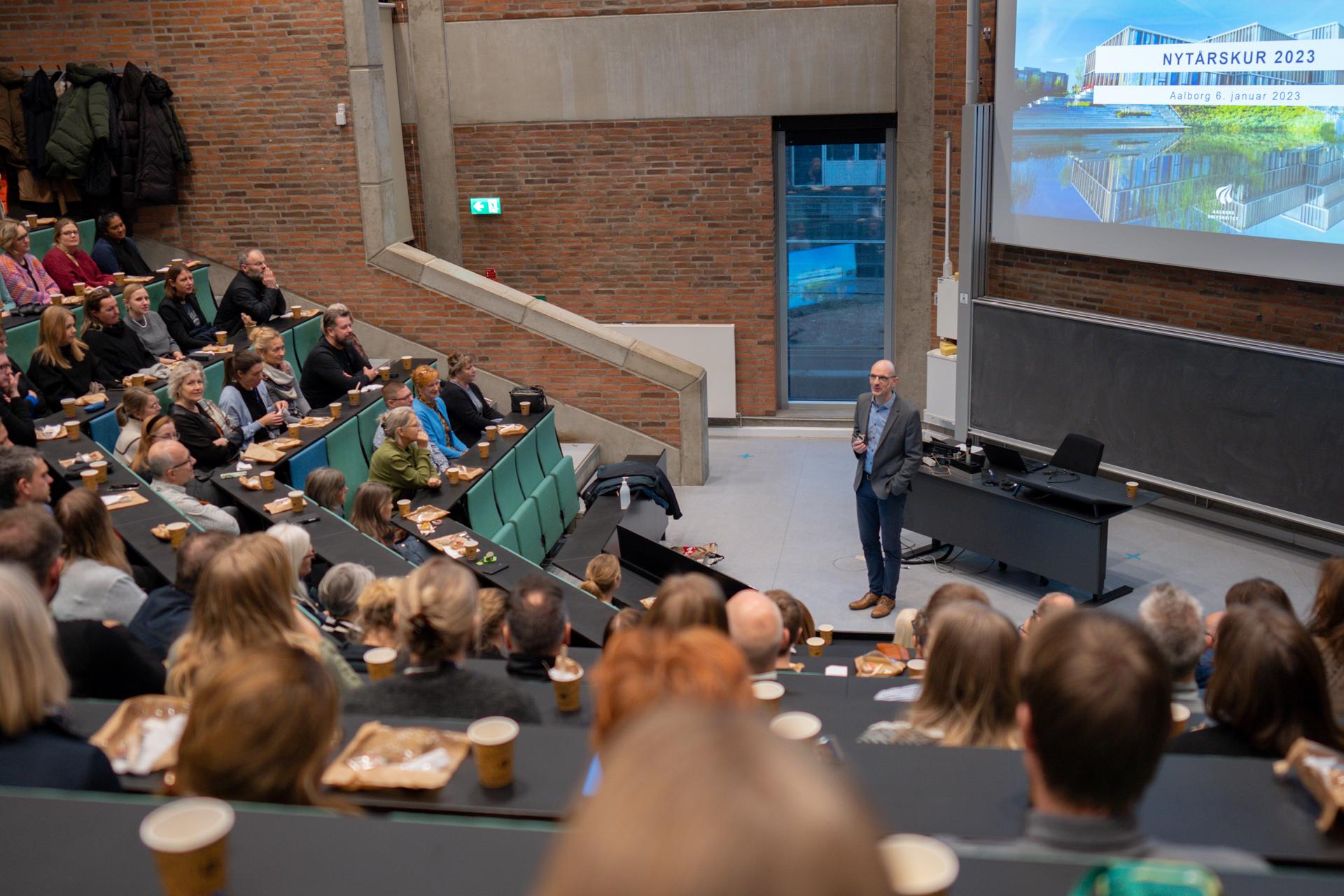
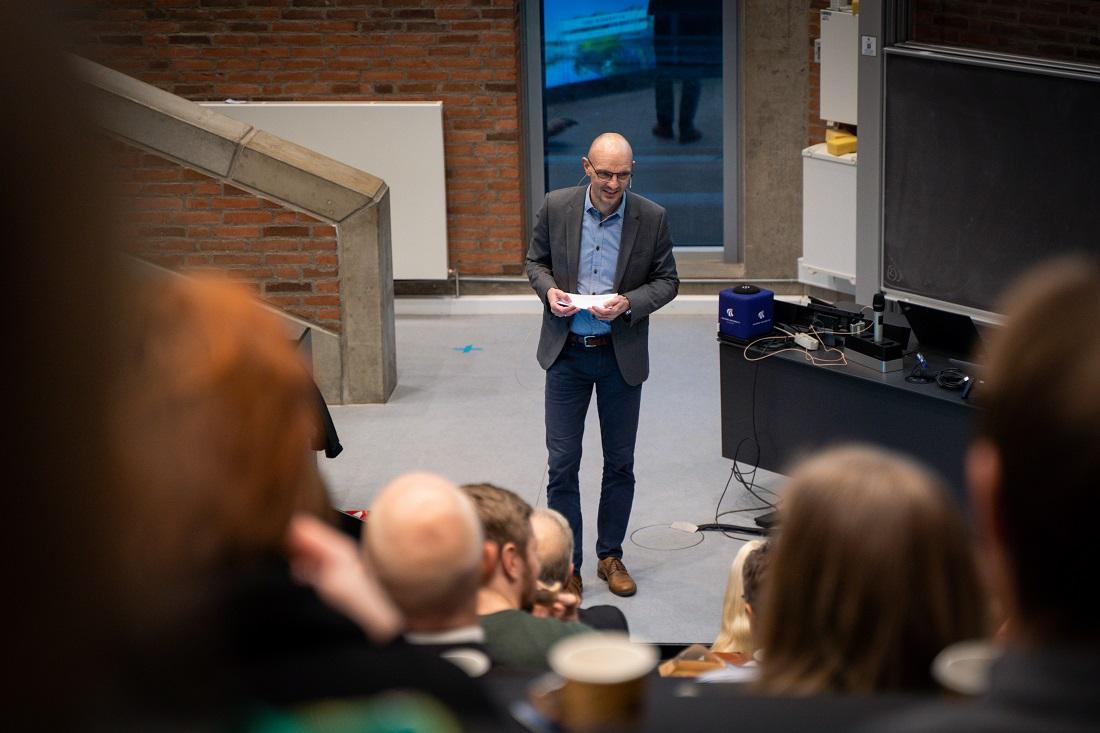
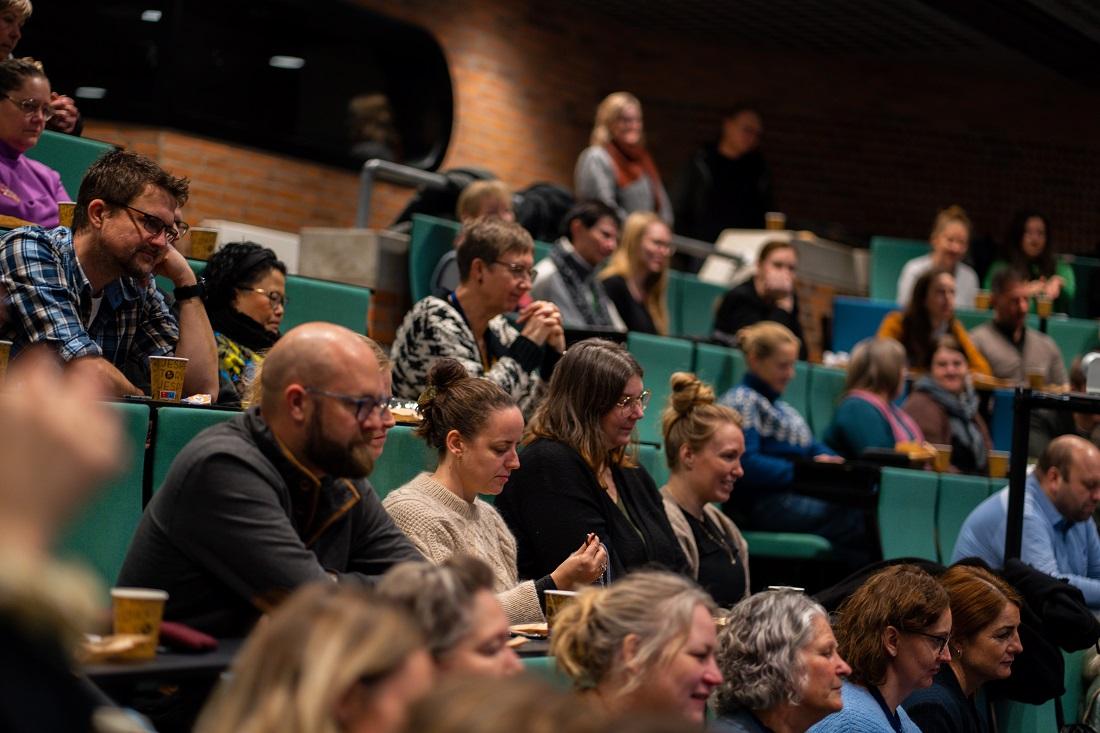
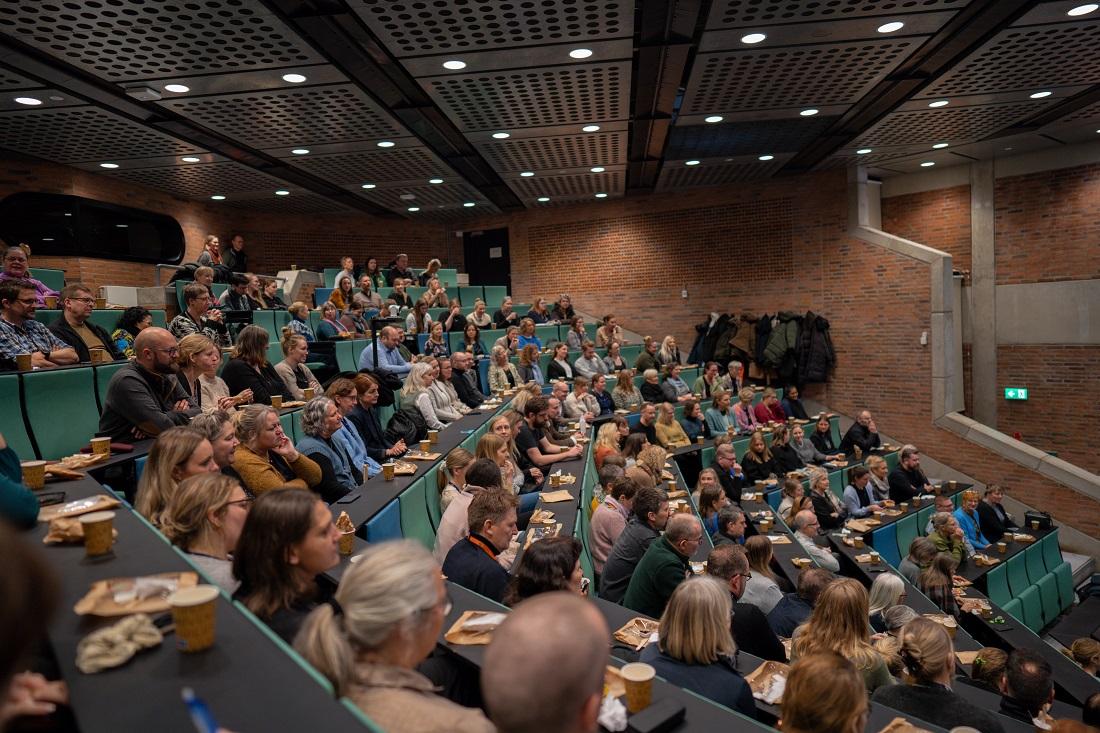
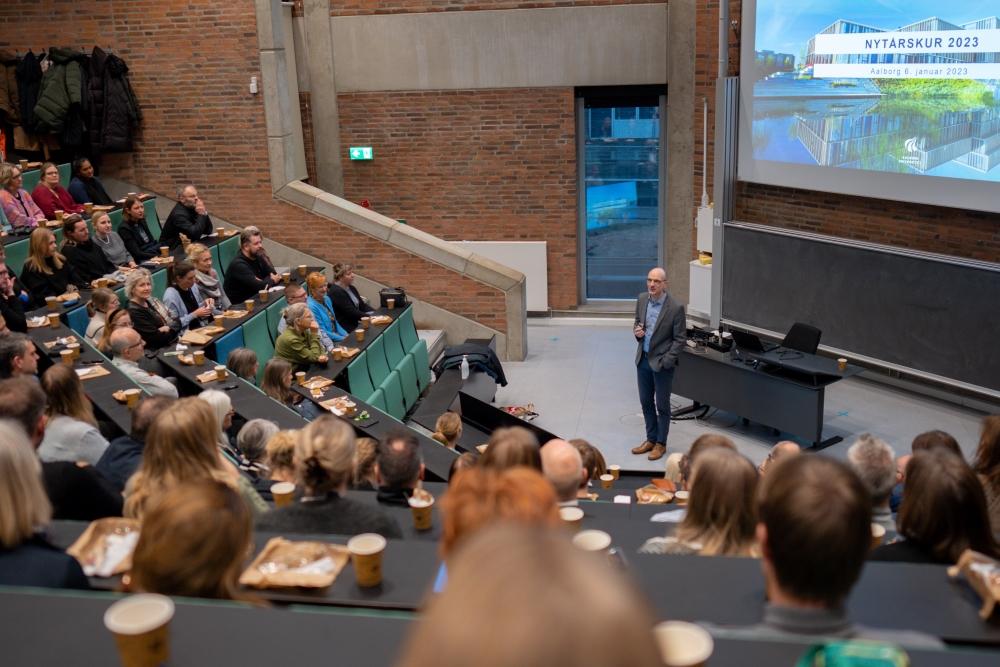
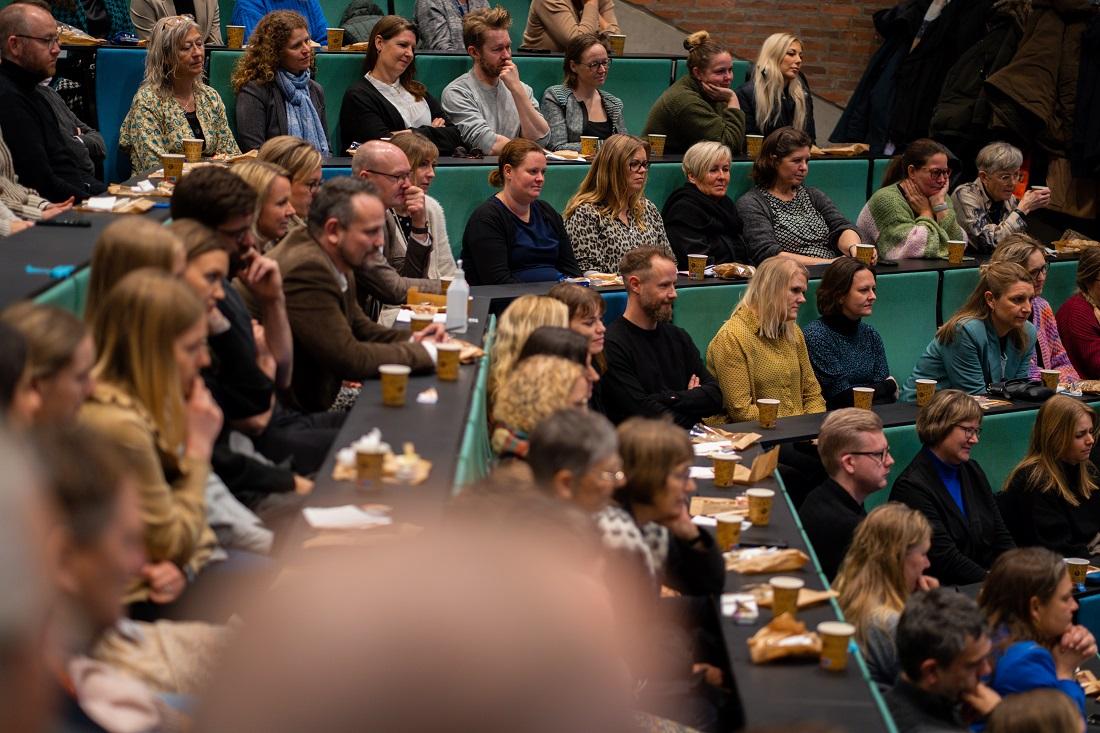
In Aalborg, around 200 staff members gathered in Auditorium B at Fibigerstræde 15, and Søren Lind Christiansen began by recalling the New Year's reception two years ago that took place online:

- It was a bit different speaking to a screen, so it's nice to stand here and feel the atmosphere in the room, the university director said.

Inner motivation

As we know, New Year’s calls for both reflections on the past year and expectations for the new. In light of the war in Ukraine, the energy crisis and inflation, it may seem difficult to be optimistic for 2023, but the university director nevertheless tried to strike an upbeat tone:

- There is plenty to be concerned about. But even though it is difficult for a West Jutlander to put it in high gear, I am actually really happy with your efforts in 2022. You do your job professionally and the quality is high, he said.

Søren Lind Christiansen reminded the audience about the inner motivation for work, which in his case is to be part of a university. An institution that both supports and prepares young people for the labour market and contributes to the growth, welfare and development of society.

Two specific AAU missions in 2023

The new SVM (Social Democrats, Liberal, Moderate) government's plans to halve the length of half of the country's Master's programmes was also mentioned. Søren Lind Christiansen offered assurance that although it may be difficult to influence decisions made by a majority government, AAU will do everything in its power to prevent the quality of education from deteriorating.

- With a new government, a historic constellation, we’ve chalked an entirely new field, and we just need to figure out how best to play on it. But one thing is certain: We must focus firmly on the great value we as a university create in society, said the university director.

In 2023, AAU's strategy of being a mission-oriented university will unfold in two specific missions that are expected to be about the well-being of children and young people as well as green energy. The decision rests with the University Board, which makes its decision in March.

In addition, the university will prepare a climate strategy with concrete goals to make AAU even more sustainable. With the winter austerity measures, it is clear how much we can change when we work together.

- I've noticed that you're good at freezing with relative calm. And I've also seen fun solutions around with blankets and fingerless mittens, but these things actually work! In October and November, we saved about 25 percent on our energy consumption compared to 2019, so we can see an effect, said Søren Lind Christiansen.

Questions about summer party, continuing education, and finances
The university director wished everyone a Happy New Year and then answered questions from the floor. One staff member suggested a summer party for Shared Services instead of a Christmas party where many perhaps prefer to be together in the individual units. Søren Lind Christiansen called for the proposal to be passed on to the consultation committee in Shared Services.

Another staff member asked about competence development in the technical-administrative area and the possibility of taking advantage of the continuing and further education offerings that exist at AAU. The university director stressed that a lot of competence development is linked to digitalisation, but that broader competence development of a more collective nature across the university could be interesting to look at.

Finally, questions were asked about the university's finances. Søren Lind Christiansen stressed while the answer is probably somewhat simplistic, AAU has used its equity in 2022 as planned. However, a deficit of DKK 50 million was budgeted that ended up at DKK 100 million. In 2023, the use of equity is also budgeted and a deficit of DKK 60 million is expected.

- We have been able to absorb some of the shocks caused by rising energy prices, for example. My view is that we are in control of our operations. We have challenges, but compared to others in the business, we aren’t hit that hard, he said.

On the Esbjerg campus, staff members asked why the university is not moving more degree programmes to Esbjerg. The university director replied that this is partly due to the university's challenges in recruiting students to Esbjerg.

In Copenhagen, staff members were concerned about the university's future plans for the AAU campus there. The programme closures affect the working environment generally, and Copenhagen staff members expressed that they lacked information about decisions affecting their campus. Søren Lind Christiansen stressed that it is definitely not a question of dismantling the campus in Copenhagen, but a transformation. According to the university director, management generally has a strong focus on the potential of Copenhagen. Head of Campus and Deputy Director Martin Vive Ivø added that a staff meeting is planned in Copenhagen on 27 January with the rector and the deans where these questions would be addressed.

Reactions to the speech

After the event on campus in Aalborg, Update spoke with Lone Levin Mortensen and Henrik Blach Poulsen from the Finance and Accounts Department. They agreed that the university director's New Year's reception is a good opportunity to look at what staff should prepare for in the new year.

- The framework for our work is set politically, but it is fine to look ahead, prepare for upcoming challenges and maybe even act well in advance. Instead of reacting after the fact, Henrik Blach Poulsen said.

In addition, the opportunity for questions is a positive thing, Lone Levin Mortensen pointed out:

- I had also thought about what a treasure trove of knowledge there is here at the university – and how our access to it can be improved. So it was great that there were questions about that, she said.

Read the university director's speech in full below:

Welcome to our little New Year's reception. It's great to see you all.

I hope that 2023 is starting out well. I sense that many people may be a bit hesitant about the year 2023. Will it be a tough year? What can we expect from the new broad government? Of the economy and employment?

There is plenty to be concerned about. At the same time, I also see that many have a sense of pride and happiness in what we do.

That is also the feeling I have today. Happiness for what we have achieved in 2022.

Pride in what we in the administrative pillar contribute every day at Aalborg University. Thank you for your great efforts in 2022.

You create the administrative scaffolding and practical skeleton that provides resilience in an organisation in constant change. And you do it at a high professional level.

With your work, you help to create growth, welfare and development in society.

This is the foremost task of the universities as enshrined in the University Act.

This is what we work for every day, regardless of whether we are employed in an administrative, research or teaching capacity.

I am proud and happy to work in a place that makes young people smarter every day. That lifts young people up and gives them access to new opportunities, good jobs, exciting lives and careers. In Denmark and internationally. A place that creates new knowledge and new solutions.

I hope you are too.

Because you have worked hard in 2022.

Thank you for your efforts and flexibility with the relocations, for the work to create a new research indicator, for the preparation of a new SIS, the roll-out of the new ERP system, the many appointments handled by HR, and for a new website.

In Esbjerg, for example, the successful social events around the West Coast Race, summer party and Christmas party.

In the case of Copenhagen, perhaps especially the handling of the start of the transformation of the Copenhagen campus with the many degree programme closures and the concerns, unrest and impact that this has had – not only on the programmes, but also in Shared Services Copenhagen, even if you are not directly affected.

To name just a few of the areas we have moved on in 2022. Because there are many more.

So we're going into 2023 definitely with heads high and positive energy.

I will not hide the fact that 2023 also presents a number of challenges.

With the new government, we are facing a transformation of our degree programmes. We're going to fight to get the best out of that.

Because we are looking at a political spring that could have far-reaching consequences for us. There is talk of ‘one-year Master's programmes'. There is talk of a shortening the state education grant. There is uncertainty about the increase in Rate 1 in the long term.

With a new government, a historic constellation, we’ve chalked an entirely new field, and we just need to figure out how best to play on it. But one thing is certain.

We must focus firmly on the great value we as a university create in society.

In addition to the curtailments in education, there will be declining youth cohorts and perhaps also high energy prices and continued high inflation.

We have therefore decided that the Executive Management should have a description of the long-term challenges for our finances and analyse how we can make ends meet in the longer term.

Fortunately, 2023 also offers exciting new tasks and challenges for us at AAU.

I would like to highlight three things in particular.

Firstly, in 2023 we will work seriously on missions. We are now officially a mission-oriented university, helping to solve some of the major societal challenges. There are many indications that our first missions will be about sustainable energy systems and the well-being of children and young people. The decision rests with the University Board, which makes its decision in March.


The special thing about working in a mission-oriented manner is that we work for a limited period of time on very specific issues, and that we work across academic disciplines in close collaboration with the wider world to solve selected major societal challenges.

In Shared Services – as in the departments and faculties – we are already working to create the best support for the missions. The best fundraising, the best management, the best communication. Our work is crucial to the success of the university.

Secondly, in 2023 we must develop a good 'digital foundation'. We will be working on a few ambitious digitalisation projects that make day-to-day life easier for students and staff at AAU and hopefully also free up resources.

We have come together at the management level across Shared Services and the departments. We have jointly identified the areas where we will benefit most from digitalisation.

We call it 'a master plan for joint digitalisation efforts in the administrative area' – yes, that sells! I would like to thank you for the commitment and willingness to work together on shared goals that I have experienced in this work.

Thirdly, in 2023 we will adopt a climate strategy with concrete targets. In the research area, we are at the forefront of developing solutions for the green transition.

Internally at AAU, we must also be frontrunners in this area. I hope that you will all help to change habits and make an effort to be "sustainable" staff members in day-to-day life, so that together we can reach our ambitious goals.

Across our development areas, we must maintain and develop our cooperation and well-being. We are a large workplace that is very much characterised by professionalism and transition.

Today, we have good working relationships within and across the individual units. This is important because almost all tasks require collaboration and working communities. And communities only work if we each contribute to them. You are already doing this, and I hope you will do so even more in 2023.