Jump to content

News

Two AAU professors honoured for their contribution to the development of special glass – MOF glass

Published online: 25.06.2025

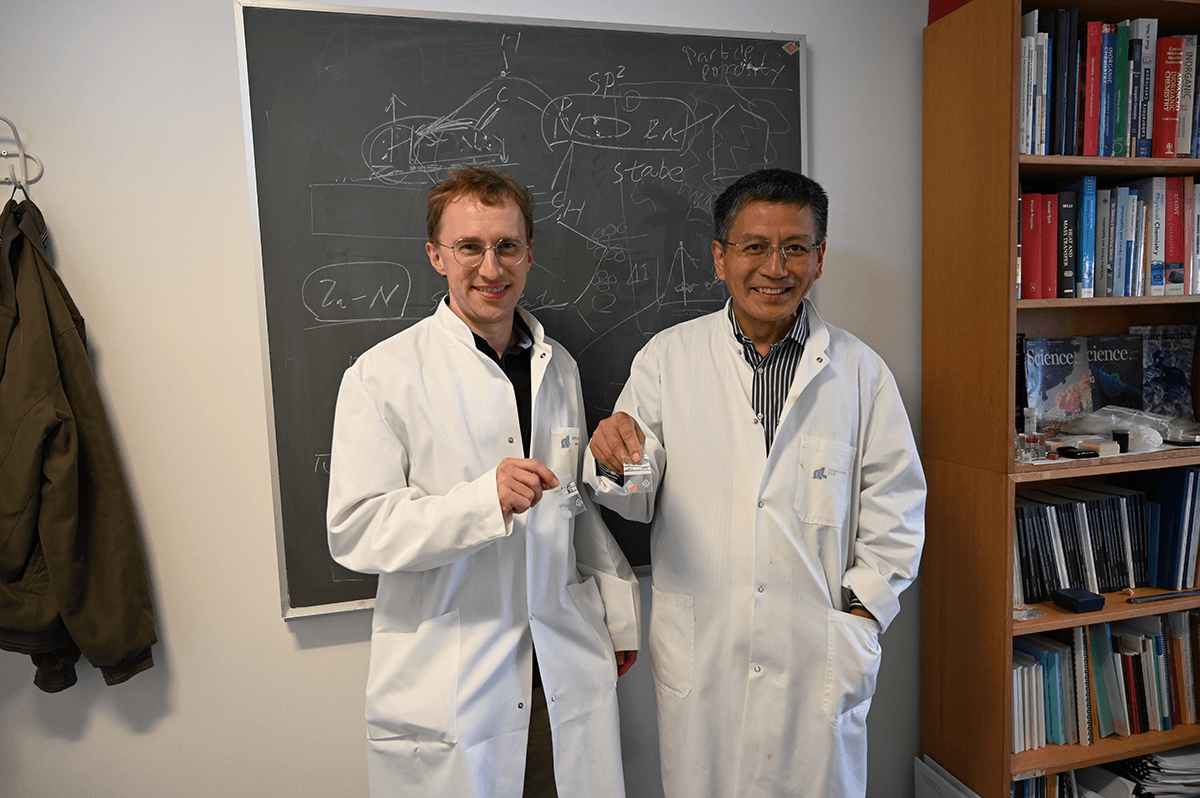
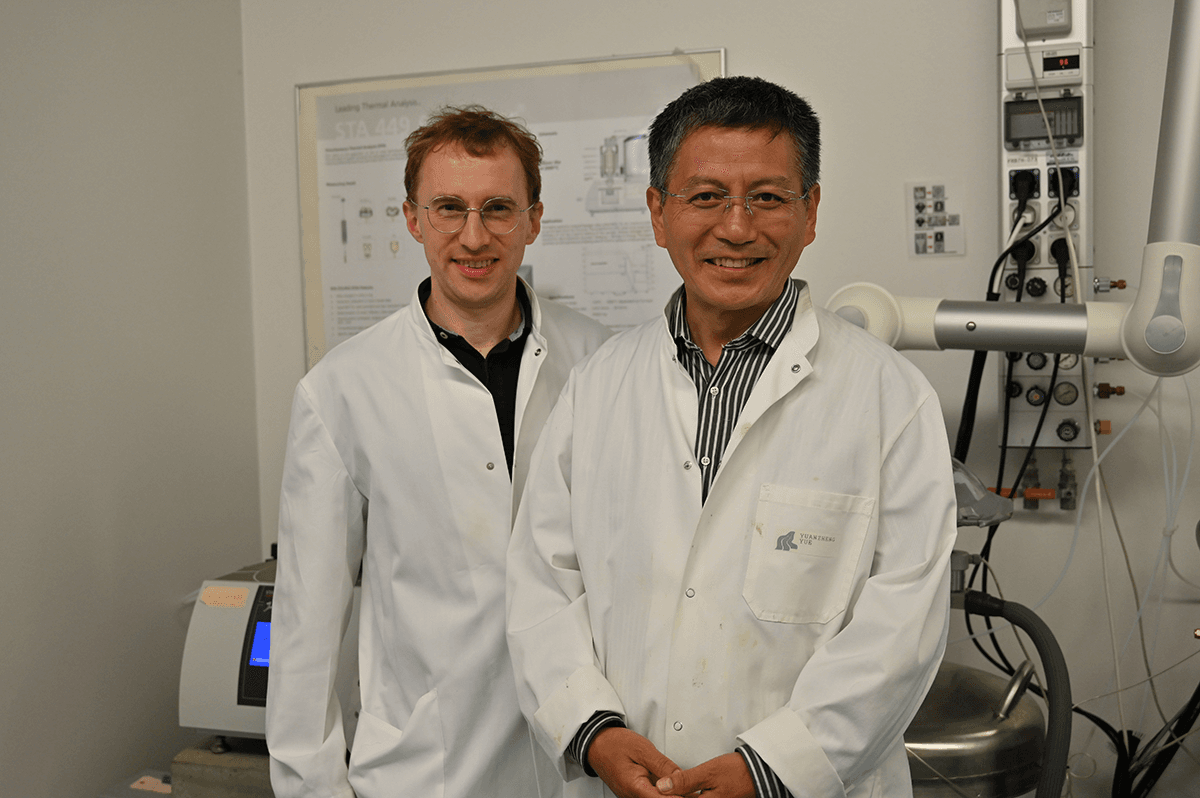
Glass researchers Yuanzheng Yue and Morten Mattrup Smedskjær were honoured with a prestigious international award for their contribution to the development of a special type of glass, MOF glass. Research on MOF glass has led to many new basic science insights and has the potential to solve several major challenges in the green transition.

News

Two AAU professors honoured for their contribution to the development of special glass – MOF glass

Published online: 25.06.2025

Glass researchers Yuanzheng Yue and Morten Mattrup Smedskjær were honoured with a prestigious international award for their contribution to the development of a special type of glass, MOF glass. Research on MOF glass has led to many new basic science insights and has the potential to solve several major challenges in the green transition.

By Dorte Larsen, Communication Specialist, AAU Communication and Public Affairs

Yuanzheng Yue and Morten Mattrup Smedskjær are considered to be among the world's leading glass researchers. They can now add another prize to their collections of honours, being among the winners of the Royal Society of Chemistry’s Dalton Horizon Prize. The prize is a group-based honour that rewards researchers who have contributed significant new discoveries or advances in the field of inorganic chemistry. A total of 17 international researchers are receiving the prize for their contribution to the discovery and development of glass based on Metal-Organic Framework (MOF).

It is a great honour that we are two researchers from Aalborg University who are among the recipients of such a distinguished international award. It is a major recognition of the importance of our research on MOF glasses.

Morten Mattrup Smedskjær, Professor

Breakthrough for glass research at Aalborg University

Yuanzheng Yue, in his 27-year career at Aalborg University, has been devoted to solving the riddles of glass. Throughout the years, he has dealt with glass materials and become highly reputed in research circles as well as international companies and professional glass organizations. 

Yuanzheng was among the first to discover MOF glass. In the lab in Aalborg, he observed the glass transition in a MOF and verified the material’s glassy state. Along with international research colleagues, he discovered and described the properties of MOF glass and its special structure. As lead author, he has published scientific articles on MOF glass in Science, Nature Communications and Science Advances, among others. Morten Mattrup Smedskjær says:
"Yuanzheng and his collaborators' major research breakthrough was the discovery that some MOF crystals – and actually only some of them – can be melted. And once in a molten state, it can be shaped and subsequently cooled down and turned into glass. Just like what a glassblower does. It may seem obvious in hindsight, but it was an impressive discovery by them back in 2014."

Elite research

Morten Mattrup Smedskjær is a younger researcher following in Yuanzheng's footsteps and his research is also devoted to glass. Shortly after the discovery, Morten began to take an interest in the special properties of MOF glasses. He and his group were very curious about what this new type of glass could be used for, which has led to significant discoveries about MOF glass. Morten explains:

"MOF glass is also called hybrid glass where hybrid denotes a mixture of something organic and something inorganic. Most of the glass materials previously known have either been organic, as in many polymers, or inorganic, like in window glass. MOF glass also has a more open and porous structure compared to other known glass materials. Overall, it gives researchers exciting opportunities to play with the chemistry and structure. We use this to investigate a number of exciting applications."

In the spring of 2025, Professor Morten Mattrup Smedskjær received the Ministry of Higher Education and Science's Elite Research Prize. This honour is seen as proof that Morten has now advanced to the international elite level in glass research. 
Facts about MOF glass

  • MOF glass, or metal-organic framework glass, is a new type of material that combines the properties of MOF crystals and traditional glass. MOF glass is known for its porous structure that makes it ideal for storing and separating gases and liquids.
  • When some MOF crystals are melted and then quickly cooled, MOF glass is formed. This glass can retain some of the porous properties of MOF crystals, but at the same time has the formability of glass. More than 100 different MOF glasses have now been discovered.
  • This means that MOF glass can potentially be used in a range of advanced applications, such as gas adsorption and separation, catalysis, energy storage, and even in optical and biomedical devices.
  • In short, MOF glass combines the best of two worlds: the high porosity and functionality of MOFs with the mechanical robustness and formability of glass.

Research on MOF glass at AAU

In addition to the basic scientific understanding of MOF glasses, research at Aalborg University primarily focuses on battery development, membrane development and water filtration as well as LED lighting.

  • Development of solid state batteries: Morten and Yuanzheng are working on a solution that can advance the development of the next generation of electric car batteries, namely the solid-state battery. By using glass-based electrolytes in a solid core, energy density can be increased and the risk of fire reduced, compared to current lithium-ion batteries. In this solution, the porous and open structure of the MOF glass is used to allow the ions to move quickly through the electrolyte. In addition, they have demonstrated that MOF glass can be used in the manufacturing of high-performance anodes for lithium-ion batteries.
  • Development of membranes: The porous and open structure of MOF glass can be utlilized to develop membranes as the pores of the glass are open and permeable. The glass membrane can help to sort and hold something back. This could be either gas or water. Research in this area is ongoing at AAU and other universities. 
  • LED lights: MOF glass can exhibit a remarkable ability to emit white light or infrared luminescence when it has the right chemical composition and has been thermally treated. Yuanzheng's group has produced the first MOF glass-based white light-emitting diode (LED).

International research and development on MOF glass is in full swing, but it will be some years before we see commercial products. The technology has the potential to revolutionize several industries in the long term, including energy storage, environmental protection and advanced materials research.

The Dalton Horizon Prize 

The Dalton Horizon Prize honours a total of 17 researchers who have all contributed to the discovery and development of MOF glasses. Both Yuanzheng and Morten emphasize the importance of international cooperation. They believe that this group-based award is appropriate in this case where the research and development of MOF glass and its applications involves collaboration of many researchers in an international environment. In addition to Yuanzheng and Morten, a number of their younger PhD students and postdocs at Aalborg University have also contributed to this work.

The award is first and foremost a great recognition of the importance of our research area on MOF glass at Aalborg University. But it also underlines the importance of the collaboration that we are part of internationally. We cannot make great innovations alone, but by working together, we can go a long way.

Yuanzheng Yue, Professor

Facts about Yuanzheng Yue

  • Dalton Horizon Prize, Royal Society of Chemistry, 2025
  • Fellow of the Society of Glass Technology, 2023
  • Fellow of the European Ceramic Society, 2023
  • Fellow of Royal Society of Chemistry, 2020
  • Fellow of the European Academy of Sciences, 2019
  • Corning Outstanding Publication Award, USA, 2015
  • Knight of the Order of Dannebrog, Denmark, 2014
     

Facts about Morten Mattrup Smedskjær

  • Dalton Horizon Prize, Royal Society of Chemistry, 2025
  • Ministry of Higher Education and Science Elite Research Prize, 2025
  • European Research Council (ERC) Consolidator Grant, 2022
  • Grundfosprisen, 2019
  • Vittorio Gottardi Prize, 2019
  • W.H. Zachariasen Award, 2019
  • Sir Alastair Pilkington Award, 2018
  • Lundbeck Foundation’s Talent Prize, 2013
  • Spar Nord Foundation Research Award 2012

Contact